Data-Driven Control of a Wind Turbine Using a Linear Model
Compare modern data-driven controllers on a realistic wind-turbine benchmark.
Supervisor: Moein Sarbandi
Programme: EU-CORE MSc
Status: Assigned
Students: Shabir Ahmad Niazi and Sahil Nesar
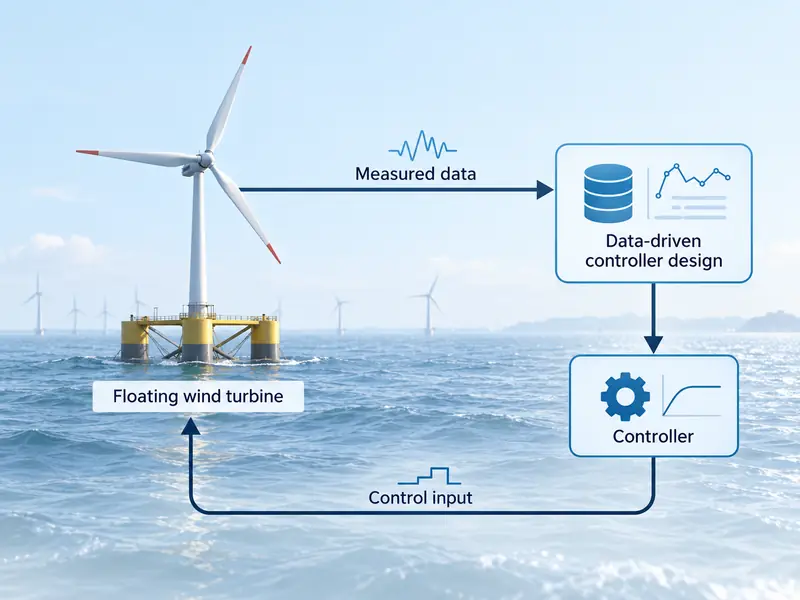
Project objective
This project develops and compares discrete-time data-driven controllers for the NREL 5 MW wind turbine. It starts from a simplified linear model at one operating point, then treats the model as unknown and designs controllers directly from simulated input-state or input-output data.
Main steps
- Obtain a linear wind-turbine model from OpenFAST or a validated reference model.
- Generate informative simulation data around a selected operating point.
- Implement data-driven state-feedback control, Data-enabled Predictive Control (DeePC) using Hankel matrices, and robust $H_\infty$ control.
- Compare reference tracking, disturbance rejection, control effort, robustness to noisy data, and sensitivity to model uncertainty.
- Test the controllers at different wind speeds and study gain scheduling, adaptive control, or online data-driven control for a wider operating range.
- If time allows, validate the most promising controller on the high-fidelity OpenFAST model.
Expected background
Basic state-space control, MATLAB/Simulink, and an interest in data-driven control. Prior OpenFAST experience is useful but not required.
Selected references
- C. De Persis and P. Tesi, “Formulas for Data-Driven Control: Stabilization, Optimality, and Robustness,” IEEE Transactions on Automatic Control, 2020.
- J. Coulson, J. Lygeros, and F. Dörfler, “Data-Enabled Predictive Control,” European Control Conference, 2019.
- H. J. van Waarde et al., “From Noisy Data to Feedback Controllers,” IEEE Transactions on Automatic Control, 2022.
- J. Jonkman et al., Definition of a 5-MW Reference Wind Turbine for Offshore System Development, NREL, 2009.