From Local Linearization to Koopman Models for Wind Turbines
Compare classical local linearization with DMDc and EDMD across operating conditions.
Supervisor: Moein Sarbandi
Programme: EU-CORE MSc
Status: Assigned
Students: Mritunjoy MOHANTA and Adrian Willian Frasson
Project objective
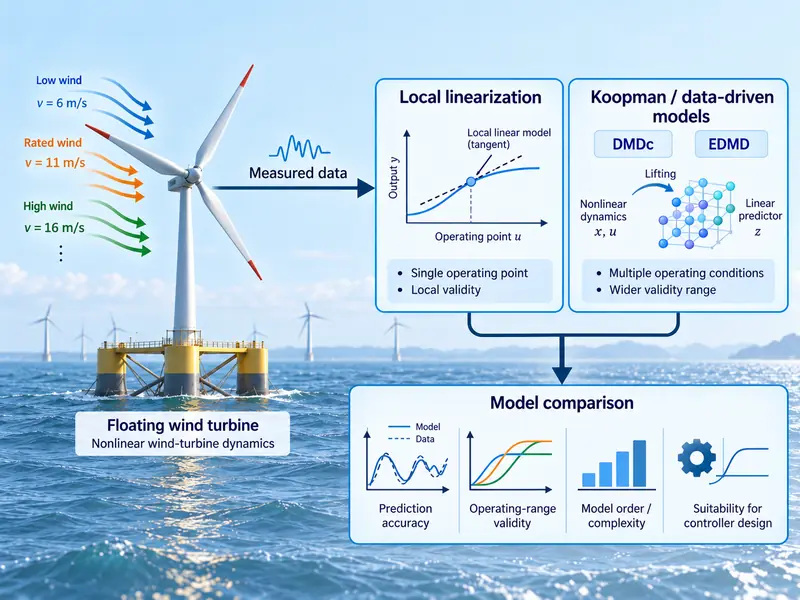
This project compares classical local linearization with data-driven Koopman representations of nonlinear wind-turbine dynamics. The central question is whether Koopman-based models can retain useful linear structure over a wider operating range than a conventional model linearized at one operating point.
Main steps
- Select a simplified nonlinear wind-turbine model and derive its classical local linearization.
- Generate data at several wind speeds and operating conditions.
- Construct alternative linear predictors using Dynamic Mode Decomposition with control (DMDc) and Extended Dynamic Mode Decomposition (EDMD).
- Compare prediction accuracy, model order, computational complexity, and validity away from the nominal operating point.
- If time allows, validate the most promising method using OpenFAST data and use the resulting model for controller design.
More advanced Koopman approaches can be explored according to the student’s progress and interests.
Selected references
- M. Korda and I. Mezić, “Linear Predictors for Nonlinear Dynamical Systems: Koopman Operator Meets Model Predictive Control,” Automatica, 2018.
- J. Liu et al., “Maximum Wind Energy Extraction of Floating Offshore Wind Turbine Using Model Predictive Control with Data-Driven Linear Predictors,” Energy, 2025.