LiDAR-Based Wind Preview and Control of Wind Turbines
Reconstruct and assess wind preview from real LiDAR data; optionally explore feedforward control.
Supervisor: Moein Sarbandi
Programme: EU-CORE MSc
Status: Assigned
Students: Muhammad Sohail Ashraf and Ahmed Kazmi
Project objective
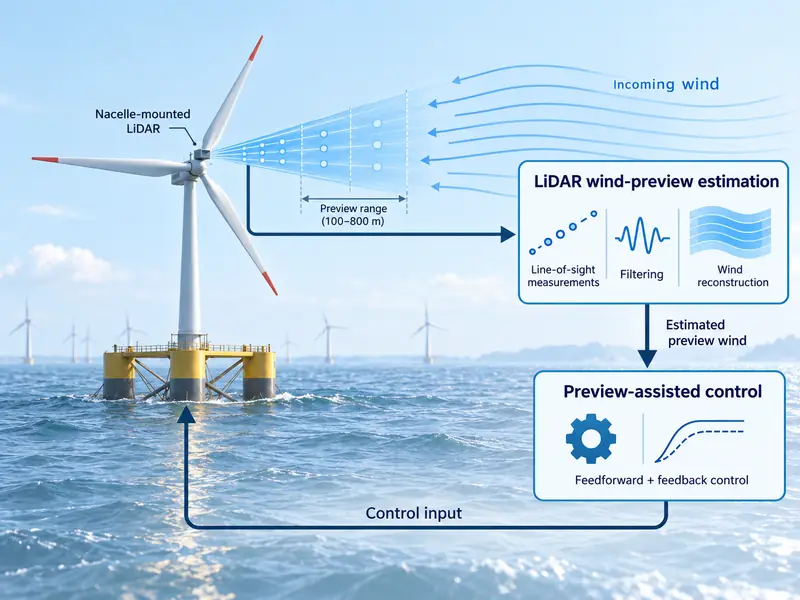
This project investigates how nacelle-mounted LiDAR measurements can be processed to estimate incoming wind before it reaches a turbine rotor. Our main goal is wind-preview reconstruction and quality assessment from real measurement data. As an optional extension, we may investigate whether the reconstructed preview improves wind-turbine control.
The project is inspired by the IEA Wind Task 52 Lidar-Assisted Control (LAC) Summer Games 2026, particularly its 6.2M Ultramarathon — Wind Preview Quality discipline. We use the published material as a research benchmark; participation in the competition is not required.
Phase 1: Wind-preview reconstruction and quality assessment (core project)
- Load and explore the real LiDAR dataset: timestamps, line-of-sight wind speeds, beam identifiers, and measurement-validity flags.
- Reproduce the provided
LDP_v3wind-reconstruction baseline, then compare a few filtering or reconstruction methods. - Assess preview quality using coherence and smallest detectable eddy size (SDES), alongside useful measures such as RMSE, bias, time alignment, and robustness to invalid measurements.
- Explain the trade-offs among reconstruction accuracy, filtering, and useful preview timing; document the work in reproducible code and a joint report.
Phase 1 alone is sufficient for this MSc project, provided the implementation, evaluation, and discussion are thorough. We will focus on completing this phase first.
No OpenFAST, ROSCO, Fortran, or 15 MW wind-turbine model is needed for Phase 1. The released field dataset and Python or MATLAB tools are sufficient. Use only current or past LiDAR signals when reconstructing the wind; the provided reference wind signal is for evaluation only, not for constructing the online estimate.
Phase 2: LiDAR-assisted control (optional extension)
If Phase 1 is completed successfully and time permits, we can test the estimated preview as a feedforward input alongside a conventional feedback controller. The 2026 example code includes a simplified turbine simulator (SLOW) that allows a first comparison of feedback-only and preview-assisted control without requiring OpenFAST.
Possible comparison criteria are rotor-speed variation, power fluctuations, pitch/control effort, and load measures available from the simplified model. This extension is encouraged if feasible but not required. Advanced aeroelastic simulations are beyond the initial scope.
Getting started: official resources
Use the SummerGames2026 branch, not the repository’s default branch.
- Summer Games 2026 — official description and instructions (Zenodo). Begin with the 6.2M Ultramarathon / Wind Preview Quality discipline.
- Official SummerGames2026 GitHub branch and README / getting-started instructions.
- Real LiDAR dataset —
DataSummerGames2026.mat. - Python baseline —
RunUltraMarathon.pyand LiDAR reconstruction algorithm —LDP_v3.py. - Python environment setup and requirements. A MATLAB version is also available.
Suggested first milestone: download and inspect the data, reproduce the provided baseline, and develop a small preview-only script for the core phase. Note that the full example runner also executes the SLOW turbine simulation for control assessment; this simulation is not needed to analyze preview quality.
For questions about the original software, the organizers maintain GitHub discussions.
Selected references
- D. Schlipf et al., IEA Wind Task 52 LAC Summer Games 2026, Zenodo, 2026. Benchmark and documentation.
- F. Guo, D. Schlipf, and P. W. Cheng, “Evaluation of LiDAR-Assisted Wind Turbine Control under Various Turbulence Characteristics,” Wind Energy Science, 2023. DOI.
- A. J. Russell et al., “LiDAR-Assisted Feedforward Individual Pitch Control of a 15 MW Floating Offshore Wind Turbine,” Wind Energy, 2024. DOI. Further reading for advanced extensions; the 15 MW model is not needed for Phase 1.