Improving Adaptive Neural-Network Integral Sliding-Mode Control for Floating Wind Turbines
Improve an existing learning-based robust controller using OpenFAST data and hybrid offline-online learning.
Supervisor: Moein Sarbandi
Programme: EU-CORE MSc
Status: Assigned
Students: Faten Jarrar and Aria Fatemi
Project objective
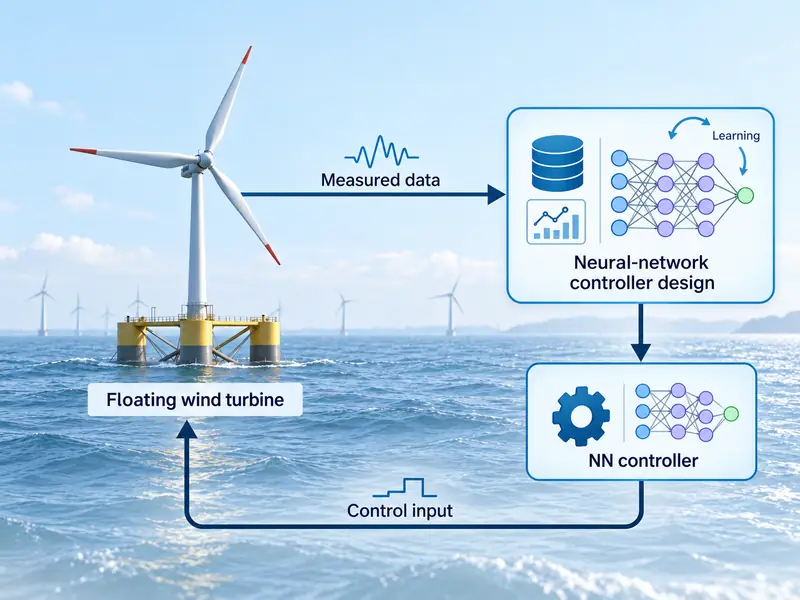
This project builds on an adaptive neural-network integral sliding-mode controller in which neural networks learn unknown floating-wind-turbine dynamics online without prior training. The goal is to reproduce the baseline controller, evaluate it systematically, and investigate practical improvements.
Main steps
- Implement the existing controller and test it at different wind speeds and operating conditions.
- Assess tracking, robustness, control effort, and structural loads.
- Introduce a warm start using neural-network weights initialized from previously collected OpenFAST data.
- Compare online learning from random initialization, offline training, and offline training followed by online adaptation.
- Explore extensions such as additional neurons or layers, alternative network structures, or higher-order sliding-mode control.
Strong results may support a research publication.
Selected references
- Background material on the existing adaptive neural-network integral sliding-mode controller is available from the supervisor upon request.
- E. Vacchini et al., IEEE Control Systems Letters, 2023.
- N. Sacchi et al., Journal of the Franklin Institute, 2024.