Data-Based Power-Coefficient Approximation for Floating Wind Turbines
Completed MSc project · EU-CORE · 2025
Students: Akbar Zai Jalil, Alam Sameer, and Adnan Nasir Isa
Supervisors: Moein Sarbandi and Mohammad Mohammadi Shahir
Programme: EU-CORE European Master Programme, École Centrale Nantes
Completed: 2025
Project focus
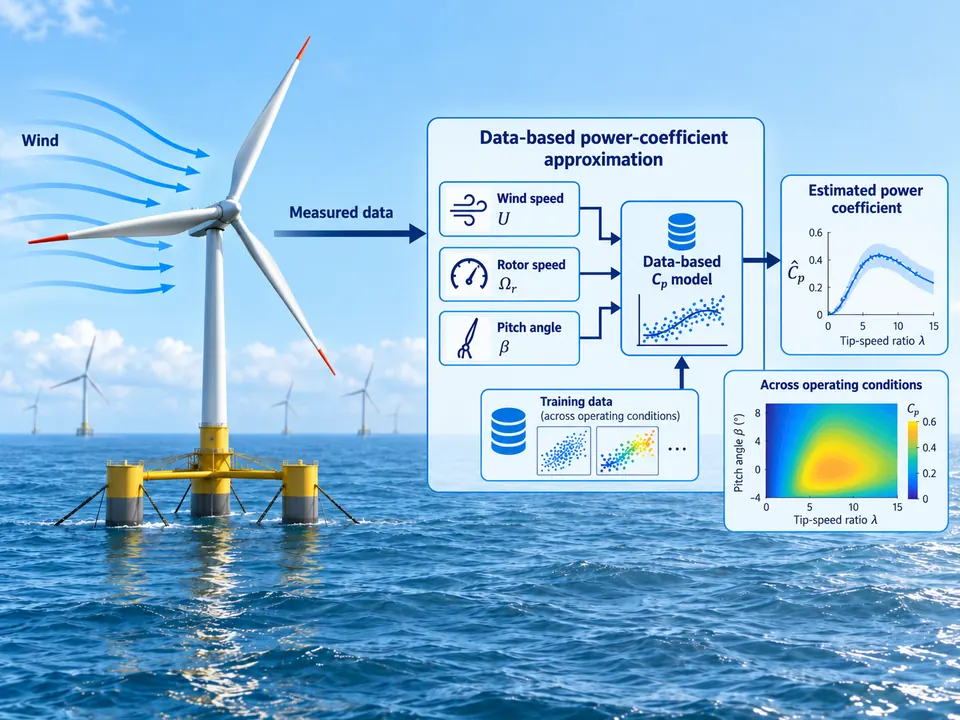
The aerodynamic power coefficient, $C_p$, is central to wind-turbine performance assessment and maximum-power-point tracking. This project investigated a data-based alternative to static analytical formulas and lookup tables by learning $C_p$ directly from high-fidelity OpenFAST simulation data.
Methods and outcomes
The students trained and compared three regression approaches:
- Polynomial regression for a smooth global approximation.
- Random forest regression for nonlinear and noise-tolerant prediction.
- Radial basis function network for accurate localized interpolation.
All three methods achieved strong agreement with the simulated reference data. The RBF model provided the best overall test-set accuracy and captured rapid variations in the power coefficient most effectively.


Related work: M. Sarbandi, M. M. Shahir, M. A. Hamida, and F. Plestan, “Online Power Coefficient Estimation in Wind Turbines via Adaptive Sliding-Mode Observers,” VSS 2026. DOI