Adaptive-Gain Laws for Rotor-Effective Wind-Speed Estimation
Completed MSc project · EU-CORE · 2025
Students: Adham Ahmed and Reza Azizollahi
Supervisor: Moein Sarbandi
Programme: EU-CORE European Master Programme, École Centrale Nantes
Completed: 2025
Project focus
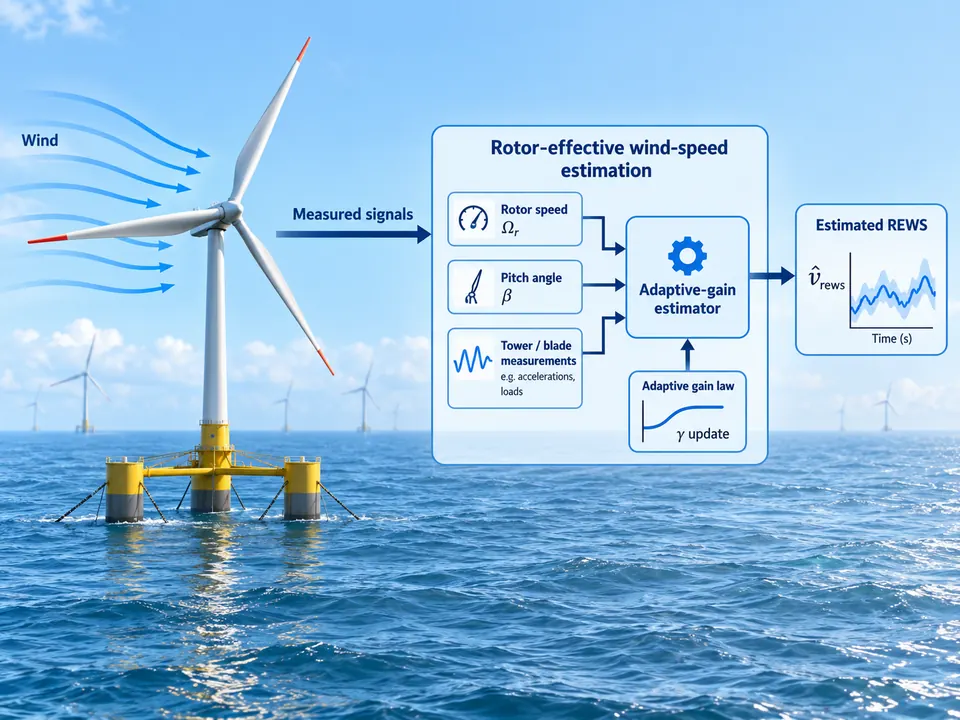
Rotor-effective wind speed (REWS) cannot be measured directly on a floating offshore wind turbine, although it is an important input for both below-rated torque control and above-rated pitch control. This project compared adaptive-gain strategies for a second-order sliding-mode observer that estimates REWS using rotor-speed measurements.
The students implemented three adaptive laws from the literature and a constant-gain baseline under identical OpenFAST conditions. The comparison focused on estimation accuracy, robustness, gain evolution, and sensitivity to turbulent wind and platform motion.
Methods and outcomes
- NREL 5 MW floating wind-turbine model in OpenFAST
- Adaptive second-order sliding-mode observation
- Matched wind and wave scenarios for all gain strategies
- Quantitative comparison using RMSE, error variance, and normalized error measures


Related publication: M. Sarbandi, M. Viozelange, M. A. Hamida, and F. Plestan, “Wind Speed Estimation Using Second-Order Sliding-Mode Observers: Simulation and Experimental Validation on a Floating Offshore Wind Turbine,” Wind Energy Science, 2026. DOI